
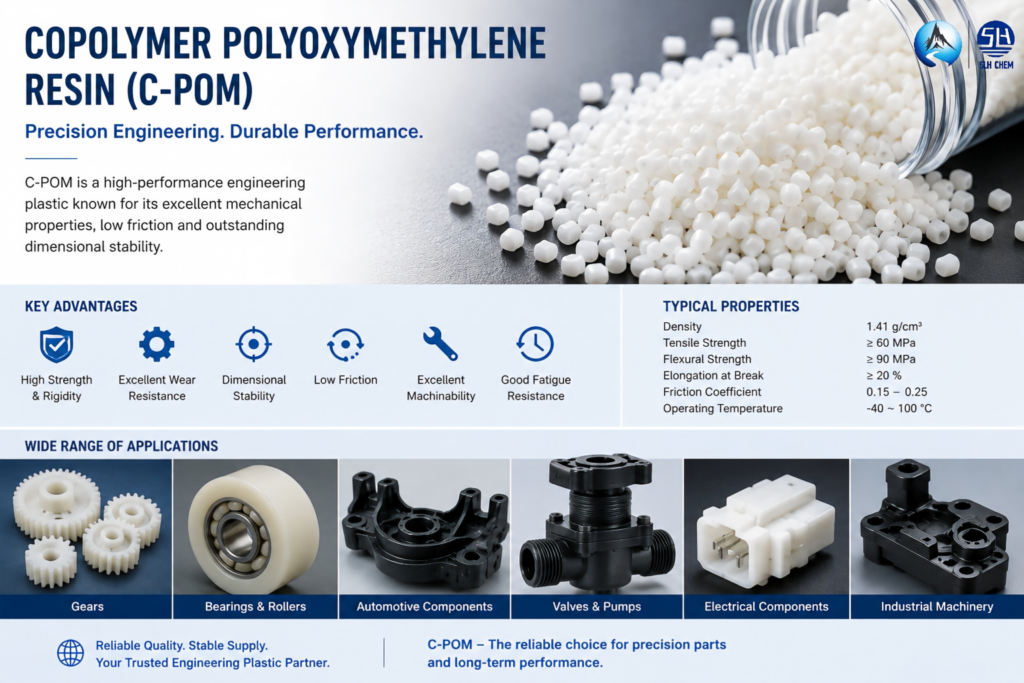
What Is Copolymer Polyoxymethylene Resin (C-POM)?
Copolymer Polyoxymethylene (C-POM), also known as Copolymer POM or Acetal Copolymer, is a high-performance engineering thermoplastic designed for applications requiring high mechanical strength, dimensional stability, low friction and excellent wear resistance.
Compared with conventional plastics, C-POM provides a combination of rigidity, durability, precision and machinability, making it suitable for demanding mechanical and industrial components.
Its balance of performance and lightweight characteristics also makes C-POM an attractive material for replacing certain metal components in applications where weight reduction and manufacturing efficiency are important.
Key Properties of C-POM
C-POM is widely selected by manufacturers because of its reliable mechanical and processing characteristics.
High Strength and Rigidity
C-POM offers high mechanical strength and rigidity, allowing molded components to maintain their structural integrity under continuous mechanical loads.
Excellent Dimensional Stability
Precision components often require tight dimensional tolerances. C-POM provides good dimensional stability, helping components maintain their shape and performance during long-term use.
Low Friction and Wear Resistance
One of the major advantages of POM is its low friction and good resistance to mechanical wear. This makes C-POM suitable for moving components such as gears, bushings, rollers and bearings.
Good Fatigue Resistance
C-POM can withstand repeated mechanical movement and cyclic loading, making it useful for components that operate continuously or undergo frequent motion.
Excellent Machinability
C-POM can be processed through common thermoplastic manufacturing methods, including injection molding and machining, providing manufacturers with flexibility in component production.
C-POM Applications
Thanks to its combination of strength, wear resistance and dimensional stability, Copolymer POM resin is used across a wide range of industries.
Automotive Components
C-POM can be used for various automotive components where lightweight construction, precision and durability are required.
Typical applications include:
- Gears
- Bushings
- Rollers
- Clips and fasteners
- Precision mechanical components
- Fuel and fluid-handling components
Industrial Machinery
C-POM is suitable for industrial equipment components exposed to continuous movement and mechanical friction.
Typical applications include:
- Gears and sprockets
- Bearings and bushings
- Rollers
- Pump components
- Valve components
- Mechanical assemblies
Electrical and Electronic Components
Its dimensional stability and mechanical performance make C-POM useful in selected electrical and electronic components, particularly where precision and durability are important.
Precision Components
For small and complex molded parts, C-POM provides a useful combination of mechanical strength, low friction and dimensional stability.
This makes it suitable for precision gears, sliding components, mechanical connectors and other engineered plastic parts.
Why Choose C-POM Instead of Conventional Plastics?
Material selection is an important factor in engineering component design.
For applications requiring more than basic plastic performance, C-POM can provide several advantages:
Strength + Precision + Low Friction + Wear Resistance + Lightweight Design
This combination allows manufacturers to develop components that can perform reliably while potentially reducing component weight and simplifying production.
In some applications, C-POM can also serve as an alternative to metal materials when the application allows the use of engineering plastics.
C-POM vs. Metal Materials
For certain mechanical applications, replacing metal with engineering plastics can provide opportunities for weight reduction and manufacturing optimization.
C-POM offers:
- Lower component weight
- Good mechanical strength
- Low friction
- Good wear resistance
- Excellent processability
- High design flexibility
However, material selection should always be based on the specific operating environment, mechanical load, temperature, chemical exposure and required service life.
C-POM for Injection Molding
Copolymer Polyoxymethylene resin is commonly processed through injection molding to manufacture complex precision components at high production volumes.
Its good flow and processing characteristics allow manufacturers to produce components with detailed geometries and consistent dimensions.
For large-scale production, C-POM can therefore provide an effective balance between material performance, production efficiency and overall manufacturing cost.
C-POM Supply for Global Manufacturers
For manufacturers, distributors and compounders, consistent resin quality and stable supply are essential.
We supply Copolymer Polyoxymethylene Resin (C-POM) for industrial and engineering plastic applications, supporting customers with product specifications, packaging options and international supply.
Whether you are sourcing C-POM for automotive components, gears, bearings, valves, pumps, electrical parts or industrial machinery, our team can provide suitable product information and supply solutions based on your requirements.
Contact us for C-POM specifications, technical data, pricing and supply options.
Frequently Asked Questions About C-POM
What is C-POM?C-POM is a copolymer form of Polyoxymethylene, also known as Acetal Copolymer, used as a high-performance engineering thermoplastic.
What are the main advantages of C-POM?The main advantages include high rigidity, mechanical strength, dimensional stability, low friction, wear resistance, fatigue resistance and good machinability.
Where is C-POM used?C-POM is commonly used in gears, bearings, bushings, rollers, automotive components, valves, pumps, electrical components and industrial machinery.
Is C-POM suitable for precision components?Yes. Its combination of dimensional stability, rigidity and low friction makes C-POM suitable for many precision-engineered plastic components.
How is C-POM processed?C-POM is commonly processed through injection molding and can also be machined for certain applications.