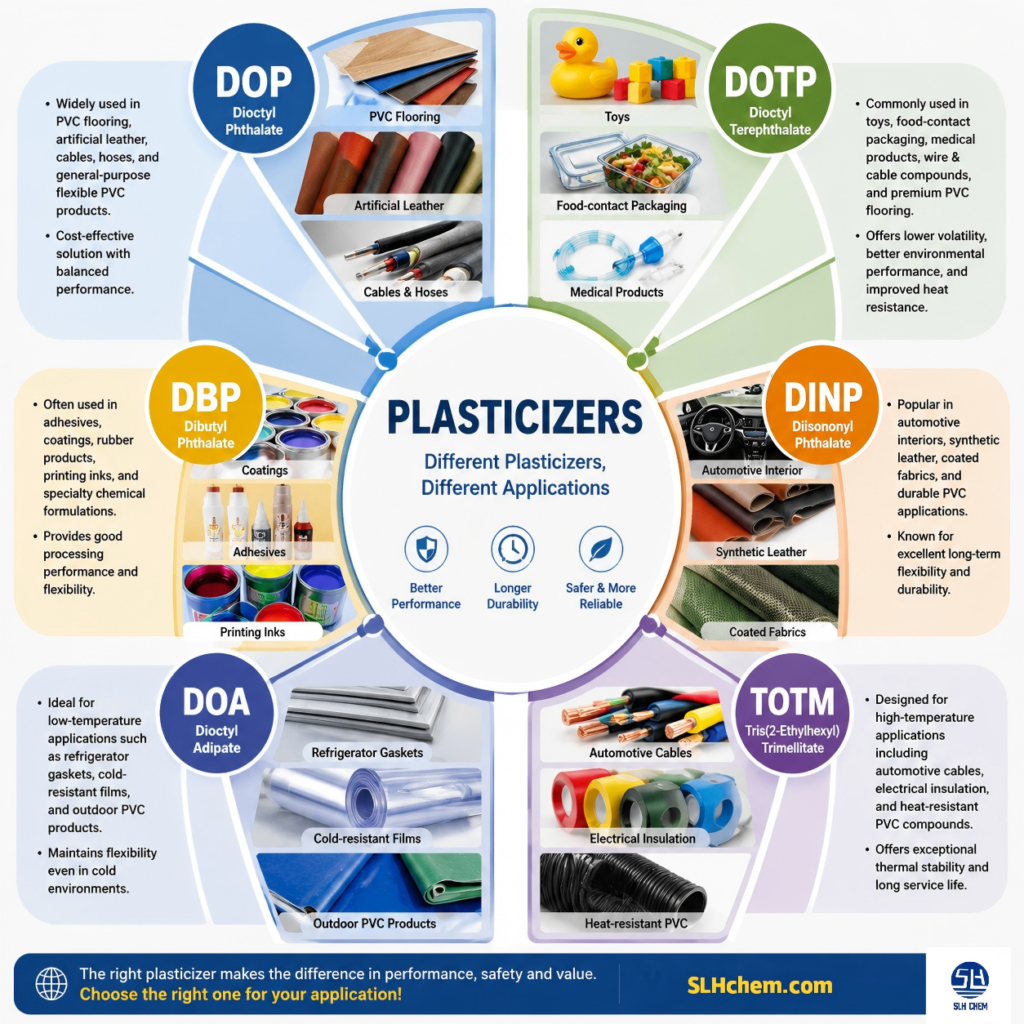
:Discover how DOP, DOTP, DINP, DBP, DOA, and TOTM plasticizers are used in different PVC applications. Learn how to choose the right plasticizer for performance, durability, and cost efficiency.
:different-plasticizers-for-different-pvc-applications
Different Plasticizers for Different Applications: Choosing the Right Plasticizer for PVC Products
In the world of PVC manufacturing, selecting the right plasticizer is just as important as selecting the right PVC resin. Different plasticizers provide different levels of flexibility, durability, heat resistance, low-temperature performance, and processing efficiency.
Whether you manufacture flooring, cables, artificial leather, automotive components, or medical products, choosing the correct plasticizer can significantly improve product quality and long-term performance.
Why Plasticizers Matter
Plasticizers are additives used to increase the flexibility and workability of PVC materials. Without plasticizers, PVC can be rigid and difficult to process. By modifying the physical properties of PVC, plasticizers help manufacturers achieve specific performance requirements for different applications.
The right plasticizer can improve:
- Flexibility
- Durability
- Heat resistance
- Low-temperature performance
- Processing efficiency
- Product lifespan
DOP Plasticizer Applications
DOP (Dioctyl Phthalate) remains one of the most widely used general-purpose plasticizers worldwide.
Common applications include:
- PVC flooring
- Artificial leather
- Flexible hoses
- Wire and cable compounds
- General-purpose flexible PVC products
DOP offers a good balance between performance and cost, making it a popular choice for many industrial applications.
DOTP Plasticizer Applications
DOTP (Dioctyl Terephthalate) has become one of the preferred alternatives for manufacturers seeking better environmental performance.
Typical applications include:
- Children’s toys
- Food-contact packaging
- Medical PVC products
- Premium PVC flooring
- Wire and cable compounds
Compared with traditional plasticizers, DOTP provides lower volatility, improved heat resistance, and excellent long-term durability.
DINP Plasticizer Applications
DINP (Diisononyl Phthalate) is commonly used in applications requiring long service life and excellent flexibility.
Major applications include:
- Automotive interiors
- Synthetic leather
- Coated fabrics
- Industrial PVC products
DINP is valued for its durability and strong performance under demanding operating conditions.
DBP Plasticizer Applications
DBP (Dibutyl Phthalate) is frequently used in specialty industrial formulations.
Common uses include:
- Adhesives
- Coatings
- Printing inks
- Rubber products
- Specialty chemical formulations
Its excellent compatibility and processing characteristics make it suitable for various industrial applications.
DOA Plasticizer Applications
DOA (Dioctyl Adipate) is widely recognized for its superior low-temperature performance.
Typical applications include:
- Refrigerator gaskets
- Cold-resistant films
- Outdoor PVC products
- Flexible packaging materials
DOA helps maintain flexibility even in extremely cold environments where conventional plasticizers may become brittle.
TOTM Plasticizer Applications
TOTM (Tris(2-Ethylhexyl) Trimellitate) is designed for demanding high-temperature environments.
Major applications include:
- Automotive cables
- Electrical insulation
- Heat-resistant PVC compounds
- Industrial wire and cable systems
TOTM provides exceptional thermal stability, low volatility, and long-term durability.
How to Choose the Right Plasticizer
There is no universal plasticizer suitable for every application. The best choice depends on factors such as:
- Product performance requirements
- Processing conditions
- Regulatory standards
- Operating temperature
- Cost targets
- Expected product lifespan
Manufacturers that focus on selecting the most suitable plasticizer often achieve better product performance and stronger market competitiveness.
Conclusion
Different plasticizers serve different purposes. DOP, DOTP, DINP, DBP, DOA, and TOTM each offer unique advantages for specific PVC applications.
Rather than choosing the lowest-cost option, successful manufacturers focus on selecting the plasticizer that best matches their product requirements. The right plasticizer can improve flexibility, durability, processing efficiency, and ultimately the quality of the final product