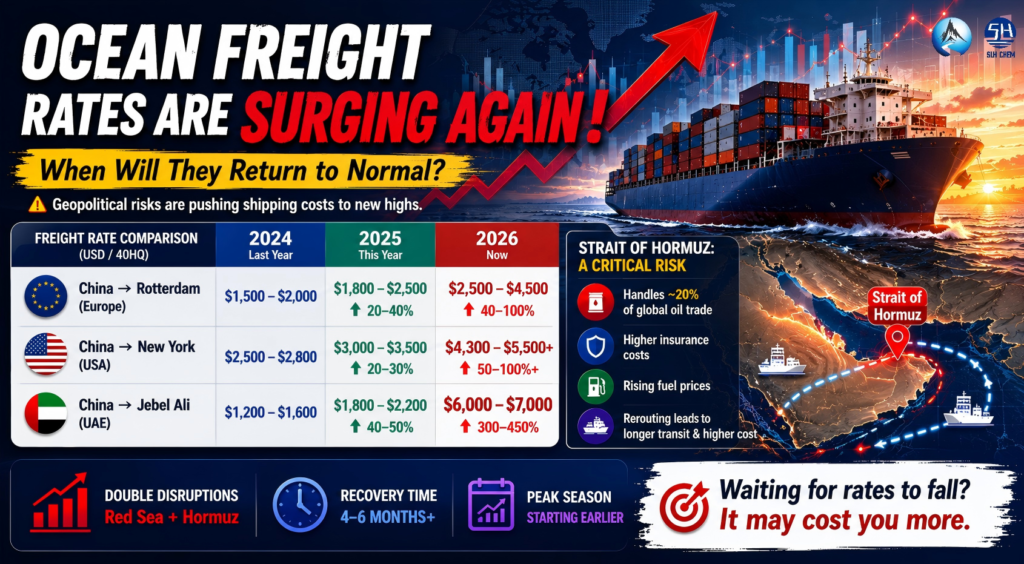
Over the past few weeks, global ocean freight rates have risen sharply once again, leaving importers and exporters asking the same question:
When will shipping costs finally return to normal?
Unfortunately, the answer is becoming increasingly uncertain.
Unlike previous freight spikes driven primarily by supply and demand imbalances, today’s market is being shaped by something much larger: geopolitics.
From ongoing disruptions in the Red Sea to rising tensions around the Strait of Hormuz, global shipping is facing multiple challenges at the same time. As a result, freight rates on major trade lanes continue to climb, putting pressure on businesses worldwide.
The Strait of Hormuz: A Critical Global Shipping Chokepoint
The Strait of Hormuz is one of the most strategically important waterways in the world.
Roughly 20% of global oil trade passes through this narrow channel connecting the Persian Gulf to international markets.
Any disruption in the region immediately affects global shipping costs.
When carriers face increased risks, they must deal with:
- Higher war-risk insurance premiums
- Rising fuel costs
- Longer sailing routes
- Vessel schedule disruptions
- Reduced shipping capacity
These additional expenses are ultimately passed on to importers through higher freight rates.
For companies relying on international trade, the impact can be significant even if their cargo never passes directly through the Middle East.
Ocean Freight Rate Comparison: 2024 vs 2025 vs 2026
The difference between current freight rates and previous years highlights how rapidly transportation costs have increased.
China to Rotterdam (40HQ)
- 2024: USD 1,500–2,000
- 2025: USD 1,800–2,500
- 2026: USD 2,500–4,500
China to New York (40HQ)
- 2025: USD 3,000–3,500
- 2026: USD 4,300+
China to Jebel Ali (40HQ)
- 2024: USD 1,800–2,200
- 2025: USD 3,000–3,800
- 2026: USD 6,000–7,000
Among all major trade routes, Middle East destinations have experienced some of the most dramatic increases. Freight rates to Jebel Ali have nearly tripled compared with levels seen just two years ago.
Why Freight Rates Continue to Rise
Several factors are currently pushing freight rates higher.
Red Sea Disruptions Remain Unresolved
Despite months of adjustments by carriers, the Red Sea situation continues to impact global shipping networks. Many vessels are still taking longer alternative routes, reducing overall market capacity.
Hormuz Tensions Add New Risks
The possibility of disruption around the Strait of Hormuz has introduced another layer of uncertainty. Shipping companies are responding by increasing risk premiums and adjusting service schedules.
Peak Season Demand Is Arriving Early
Many importers are accelerating purchases to avoid future supply chain disruptions. This early demand surge is putting additional pressure on available vessel space.
Equipment and Schedule Imbalances
Container repositioning and schedule recovery take time. Even when disruptions ease, shipping networks often require months to return to normal operating conditions.
Will Freight Rates Return to Normal?
Many buyers are delaying purchases in the hope that freight rates will fall.
However, history suggests that freight markets rarely recover immediately after a crisis ends.
Even if geopolitical tensions ease tomorrow, carriers will still need time to:
- Reposition empty containers
- Restore vessel schedules
- Clear cargo backlogs
- Normalize equipment availability
Industry experts estimate that full recovery could take four to six months after conditions improve.
What Importers Should Consider
For importers of chemicals, plastics, PVC, plasticizers, and other bulk commodities, waiting for freight rates to return to historical lows may not be the most effective strategy.
In today’s environment, logistics uncertainty often represents a greater risk than product pricing itself.
Businesses that secure inventory, diversify supply chains, and plan shipments earlier are generally better positioned to manage market volatility.
Conclusion
Ocean freight rates are rising again, and the reasons extend far beyond traditional market cycles.
With ongoing Red Sea disruptions, uncertainty surrounding the Strait of Hormuz, and early peak-season demand, shipping costs may remain elevated for longer than many businesses expect.
The question is no longer:
“When will freight rates fall?”
The more important question is:
“Can your supply chain afford to wait?”