Most people think politics and trade are separate.
They are not.
Every major geopolitical shift first appears in energy prices, shipping routes, and currency settlement systems — long before it becomes visible in headlines.
For global chemical markets such as PVC plasticizers (DOP, DOTP, DINP), these shifts are not abstract discussions. They directly influence pricing, supply stability, and long-term procurement strategies.
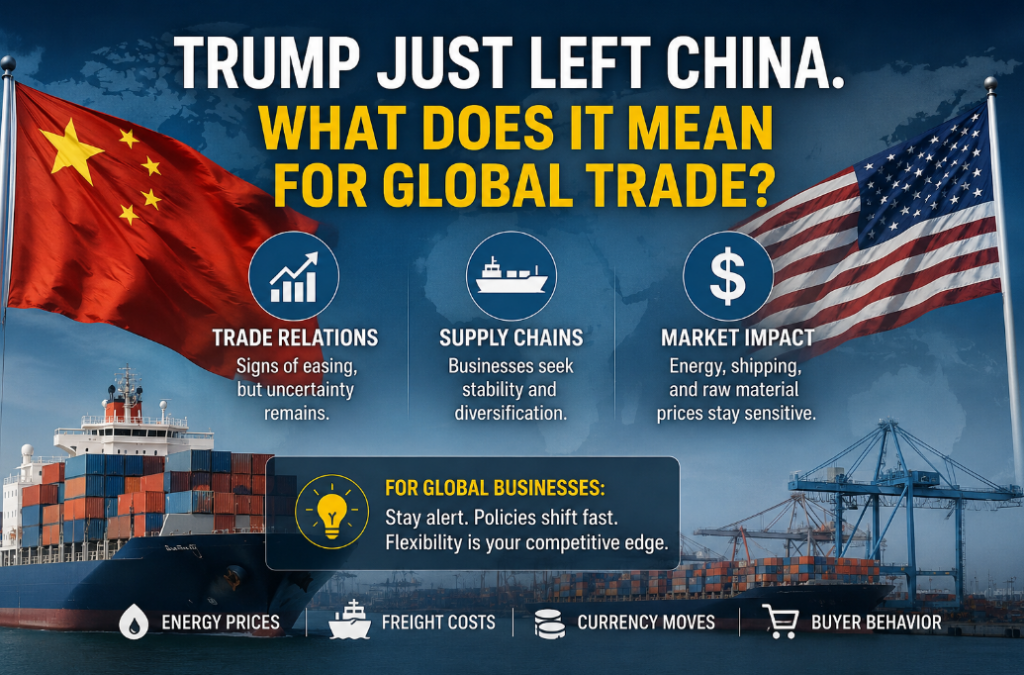
Trump’s visit to China and Putin’s international engagements are often interpreted as diplomatic events. But the deeper layer is not diplomacy itself — it is the ongoing restructuring of global economic influence.
China represents large-scale manufacturing capacity. Russia represents energy and raw material strength. One controls production, the other controls resources. Together, they form a key axis in the evolving global trade structure.
This is also why the global market is gradually moving toward a more diversified settlement system, including increased use of RMB in cross-border trade, expansion of BRICS economic cooperation, and the development of alternative Eurasian logistics routes. These are not isolated events, but parts of a broader adjustment in how global trade is organized and settled.
For traders in chemicals, plastics, and plasticizers, these macro changes translate into very real market consequences.
When geopolitics shifts, energy markets react first. Crude oil movements directly affect upstream chemical feedstocks. Shipping routes and freight costs adjust next, changing delivered pricing structures. Currency fluctuations then reshape import and export competitiveness.
In the PVC plasticizer industry, this is especially visible. Products like DOP and DOTP are closely tied to upstream petrochemical pricing and global logistics conditions. Even small changes in crude oil or freight costs can quickly be transmitted into market quotations.
At the same time, we are also seeing structural demand changes. DOP continues to maintain strong demand in cost-sensitive markets, while DOTP is increasingly adopted in regions with stricter environmental and regulatory requirements. This dual-track development is becoming more obvious as global compliance standards evolve.
Today, buyers are no longer evaluating suppliers based only on price differences. The real question has changed.
It is no longer simply “who is cheaper,” but rather “who can remain stable if global conditions shift again.”
This reflects a deeper transformation in global chemical sourcing — from pure cost competition to risk-aware supply chain strategy.
In reality, geopolitics does not stay in political discussions. It moves through oil markets, freight systems, chemical pricing structures, and ultimately shapes decisions in industries like PVC and plasticizers.
For global traders and manufacturers, understanding these connections is becoming as important as understanding pricing itself.