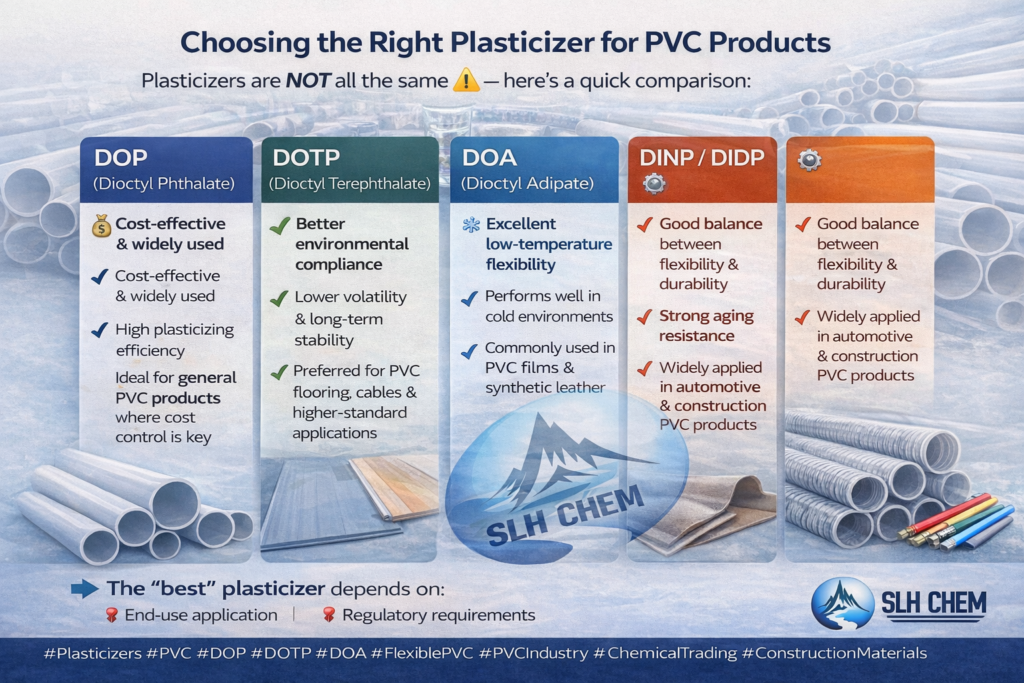
Plasticizers are a critical component in PVC manufacturing, directly influencing flexibility, durability, processing performance and long-term stability.However, plasticizers are NOT all the same — choosing the right one truly matters.
In PVC and flexible material applications, different plasticizers deliver very different performance results. Understanding these differences helps manufacturers and traders avoid mismatched formulations, compliance risks and unnecessary costs.
Below is a practical comparison of commonly used PVC plasticizers.
DOP Plasticizer (Dioctyl Phthalate)
DOP is one of the most widely used plasticizers in the global PVC industry, mainly due to its excellent cost-performance balance.
Key characteristics:
- High plasticizing efficiency
- Good compatibility with PVC resin
- Cost-effective and easy to process
Typical applications:
- General PVC products
- Flexible PVC sheets and profiles
- Hoses and molded PVC items
DOP is ideal for applications where cost control is a priority and regulatory requirements are relatively flexible.
DOTP Plasticizer (Dioctyl Terephthalate)
DOTP is increasingly replacing traditional phthalates in many markets, especially where environmental and regulatory standards are higher.
Key characteristics:
- Better environmental compliance
- Lower volatility and reduced migration
- Improved long-term stability
Typical applications:
- PVC flooring
- Wires and cables
- Higher-standard flexible PVC products
DOTP is preferred when product longevity, stability and regulatory acceptance are important.
DOA Plasticizer (Dioctyl Adipate)
DOA is well known for its excellent performance in low-temperature environments, offering superior flexibility compared to many other plasticizers.
Key characteristics:
- Outstanding low-temperature flexibility
- Soft touch and good processing behavior
- Maintains performance in cold conditions
Typical applications:
- PVC films
- Synthetic leather
- Cold-resistant flexible PVC products
DOA is often selected when flexibility at low temperatures is a key requirement.
DINP / DIDP Plasticizers
DINP and DIDP are commonly used in applications that require a balance between flexibility, durability and aging resistance.
Key characteristics:
- Good balance between flexibility and mechanical strength
- Strong aging and weather resistance
- Suitable for long-term use
Typical applications:
- Automotive PVC components
- Construction materials
- Industrial flexible PVC products
These plasticizers are widely applied where durability and service life are critical.
How to Choose the Right Plasticizer for PVC
There is no “one-size-fits-all” plasticizer. The best choice always depends on multiple factors, including:
- End-use application
- Regulatory and environmental requirements
- Target market standards
- Cost and performance balance
Selecting the right plasticizer helps ensure consistent product quality, compliance and long-term performance — while also supporting more efficient sourcing decisions.
Understanding these differences allows manufacturers and traders to make smarter, more informed choices in the PVC supply chain.