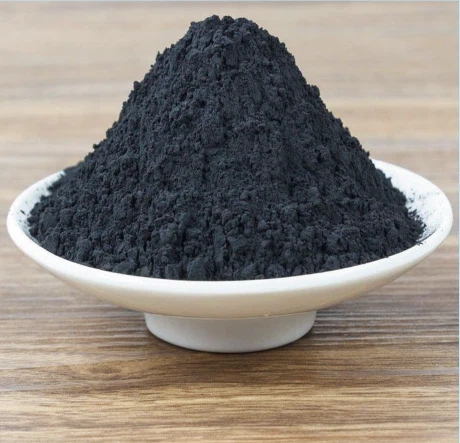
Carbon Black
Carbon Black
CASNo.: 1333-86-4
It is mainly used as a reinforcing agent and filler for rubber. It is alsO used as a colorant for inks, paints and plastics,and as a UV screen agent for plastics. It is also an important additive in many other products, such as electrodes, dry cells, resistors,explosives,cosmetics and polishing pastes. Rubber with carbon black such as tire industry, rubber seals, shock absorption parts, rubber products with a certain amount of carbon black can play a reinforcing and fil1- ing role, in order to improve the performance of rubber products.
Packing: 20kg bag
产品详情
Carbon Black is a form of paracrystalline carbon, produced by the incomplete combustion or thermal decomposition of hydrocarbons (such as oil, natural gas, or coal tar) under controlled conditions. It is a black, powdery or granular material with high surface area, strong tinting strength, and good conductivity.
Core Characteristics
- Physical Properties
- Fine particle size (typically 10–500 nm)
- High specific surface area (10–1500 m²/g)
- Low bulk density; lightweight and easy to disperse in matrices like polymers.
- Chemical Properties
- Chemically inert in most environments, with high thermal stability.
- Surface can be modified (e.g., oxidized, coated) to improve compatibility with resins or other materials.
Main Production Methods
- Furnace Black Process (most common, ~90% of global output): Hydrocarbons are burned in a hot furnace with limited oxygen; the resulting soot is cooled, collected, and processed.
- Channel Black Process: Hydrocarbons are decomposed on hot metal channels; suitable for high-quality pigments but less energy-efficient.
- Thermal Black Process: Hydrocarbons are pyrolyzed at high temperatures without oxygen; produces larger particle sizes for rubber reinforcement.
Key Applications
- Rubber Industry (largest end-use, ~70%): Acts as a reinforcing filler in tires, belts, and hoses. It improves tensile strength, abrasion resistance, and durability of rubber products.
- Plastics & Polymers: Used as a pigment, UV stabilizer, and conductivity additive in PVC, polyethylene, and engineering plastics (e.g., for black plastic pipes, automotive parts, and packaging).
- Inks & Coatings: Provides deep black color and opacity in printing inks, industrial coatings, and paints.
- Other Uses: Conductive materials for batteries, electrodes, and electrostatic discharge (ESD) products; additives in cement and fertilizers.