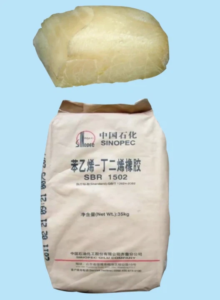
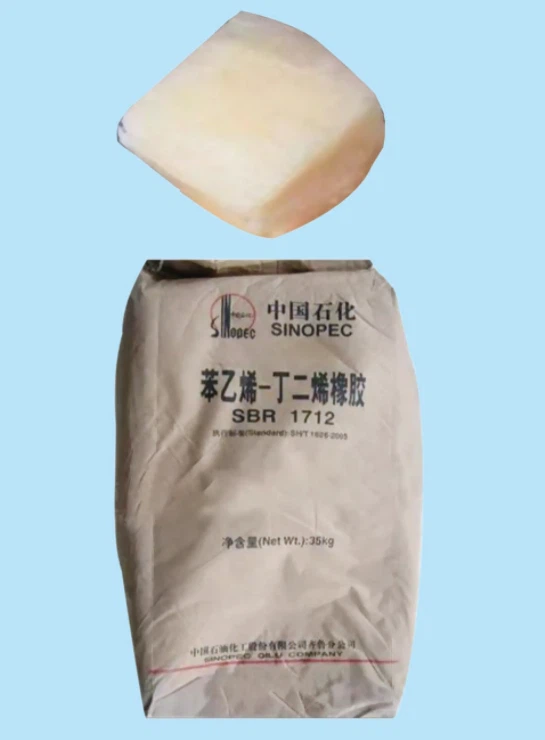
SBR-1712
Styrene Butadiene Rubber(SBR)1712
CAS NO: 9003-55-8
SBR is a kind of synthetic rubber, and it is also the variety with the highest output and largest consumption in synthetic rubber.SBR has good comprehensive performance and is mainly used in the production of various rubber products such as tires,auto parts,footwear,and hoses.
Packing: 35kg/bag
产品详情
Styrene Butadiene Rubber (SBR) is a synthetic copolymer elastomer produced by the polymerization of styrene and butadiene monomers. It is one of the most widely used general-purpose rubbers globally, with performance similar to natural rubber (NR) but offering better abrasion resistance and cost-effectiveness.
1. Basic Chemical Properties
- Chemical Structure: Random copolymer of styrene (C₈H₈) and butadiene (C₄H₆); styrene content typically ranges from 10–30% (dictates hardness and rigidity).
- CAS Number: 9003-55-8
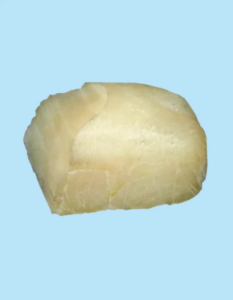
- Physical Appearance: Off-white to pale yellow solid; supplied in bales, pellets, or latex form.
- Key Metrics:
- Hardness: 40–90 Shore A (adjustable via formulation).
- Temperature resistance: -50°C to +100°C (continuous use).
- Glass transition temperature (Tg): Ranges from -55°C (low styrene) to -30°C (high styrene).
- Solubility: Swells in aromatic hydrocarbons, chlorinated solvents, and oils; insoluble in water and aliphatic hydrocarbons.
2. Core Classification & Production Methods
SBR is primarily categorized by its polymerization process:
| Type | Production Process | Key Features | Typical Uses |
|---|---|---|---|
| Emulsion SBR (E-SBR) | Polymerized via emulsion polymerization (most common, ~70% of global production) | Low cost, good processability, excellent abrasion resistance | Tires (tread and sidewall), conveyor belts, footwear |
| Solution SBR (S-SBR) | Polymerized via solution polymerization | Better elasticity, lower rolling resistance, higher tensile strength | High-performance tire treads (fuel-efficient tires), rubber hoses |
3. Performance Traits (Driven by Styrene Content)
The styrene content directly balances SBR’s flexibility, hardness, and wear resistance:
- Low styrene (10–15%): High elasticity, good low-temperature flexibility, similar to natural rubber; used for cold-resistant parts.
- Medium styrene (20–25%): Balanced abrasion resistance, elasticity, and processability; ideal for general-purpose applications.
- High styrene (25–30%): Increased hardness, rigidity, and wear resistance; used for hard rubber goods (e.g., shoe soles, gaskets).
4. Main Applications
SBR is a staple in rubber manufacturing due to its versatility and cost-effectiveness:
- Tire Industry: Dominant raw material for tire treads, sidewalls, and inner liners (E-SBR for standard tires; S-SBR for eco-friendly, low-rolling-resistance tires).
- Footwear: Shoe soles, heels, and rubber boots (high wear resistance and low cost).
- Industrial Goods: Conveyor belts, hoses, gaskets, seals, and vibration dampeners.
- Latex Applications: Adhesives, carpet backings, paper coatings, and disposable gloves.
- Consumer Products: Toys, rubber bands, and sports equipment.
5. Advantages & Limitations
| Advantages | Limitations |
|---|---|
| Low cost compared to natural rubber | Poor oil and solvent resistance (inferior to NBR) |
| Excellent abrasion and wear resistance | Lower tensile strength and elasticity than natural rubber |
| Good processability (easy to mix with fillers and additives) | Poor ozone and weathering resistance (requires anti-aging additives) |
| Consistent quality (less variability than natural rubber) | Higher compression set than NR |
6. Comparison with NBR
| Property | SBR | NBR |
|---|---|---|
| Oil Resistance | Poor | Excellent |
| Abrasion Resistance | Excellent | Good |
| Low-Temperature Flexibility | Good | Moderate (depends on ACN content) |
| Cost | Low | Moderate |
| Best For | Tires, general industrial goods | Oil seals, fuel hoses, solvent-resistant parts |